Why did SG Finserve crash 23% on Tata Steel-APL Apollo deal?

On 25 November, SG Finserve hit its 20% lower circuit and closed around ₹630. The day before, it closed at about ₹788. It had touched ₹833.95 on 18 November. SG Mart, another company run by the same family, fell the same way.
SG Finserve itself had filed nothing. As of 27 November, it hasn’t said a word about the Tata Steel–APL Apollo deal. Its own results, six weeks earlier, were its best yet.
So why did it fall? SG Finserve lends to APL Apollo’s dealers, though those loans are now about a quarter of its book. It also borrows on the Gupta family’s backing. About two-thirds of SG Finserve’s debt is guaranteed by its promoter group, and the company behind the main guarantee is the one selling APL Apollo to Tata Steel.
We make no buy or sell call here. This is what the filings and rating reports say about how SG Finserve is tied to APL Apollo, what the Tata deal changes, and what it doesn’t.
- ~25% of loans are linked to the APL Apollo ecosystem (Sep 2026)
- ~2/3 of debt is guaranteed by the promoter group (Jun 2026)
- A+ → AA(CE): what the promoter guarantee does to its ICRA rating
- 0 SG Finserve disclosures on the Tata deal
The deal, from SG Finserve’s side
Tata Steel is buying 26.38% of APL Apollo from S Gupta Holding, the Gupta family’s holding company, at ₹2,100 a share. That’s ₹15,511 crore, paid in three tranches. The first, about 10%, went through on 23 November. Tata Steel will also make an open offer for another 26% at ₹2,301.40.
After the first tranche, the Gupta family’s promoter group holds 18.19% of APL Apollo. Separately, APL Apollo is buying Tata Steel’s tube and colour-coated steel plants for ₹28,000 crore. We covered that half in our APL Apollo piece.
SG Finserve is not a party to any of it. The only SG company in the deal papers is SG Spectra, which will make colour-coated steel for APL Apollo. It has nothing to do with lending.
Built to lend to APL Apollo’s dealers
SG Finserve used to be Moongipa Securities. Rahul and Rohan Gupta, of the family that promotes APL Apollo, bought 56.25% of it in August 2021. Crisil’s September 2026 report says it was bought to work as the “financing unit of the APL Apollo group”.
APL Apollo’s dealers needed working capital, and banks weren’t keen to lend to them. SG Finserve was set up to fill that gap.
A dealer orders steel tubes. SG Finserve pays APL Apollo for them, and the dealer repays SG Finserve. SG Finserve’s systems are linked to APL Apollo’s, so it sees what each dealer buys and owes. If a dealer falls behind, APL Apollo stops supplying it. That “stop-supply” arrangement is backed by a letter of comfort from APL Apollo, according to Crisil’s 2025 rating reports.

SG Finserve has two links to the Gupta family. On the lending side, dealer loans run through APL Apollo’s supply chain. On the borrowing side, banks lend to SG Finserve with the family standing behind most of it. The Tata Steel deal touches both.
Crisil notes that APL Apollo’s dealers have bought from it for about three decades, and its bad debts have stayed within 0.2% for the last ten years.
A quarter of the book, and still growing
SG Finserve started lending in 2022. By December 2023 its loan book was ₹1,891 crore. Then it shrank to ₹822 crore by September 2024, while it waited for its NBFC licence to move to a different category, Type I to Type II, per Crisil. Lending picked up again from October 2024, once that came through.
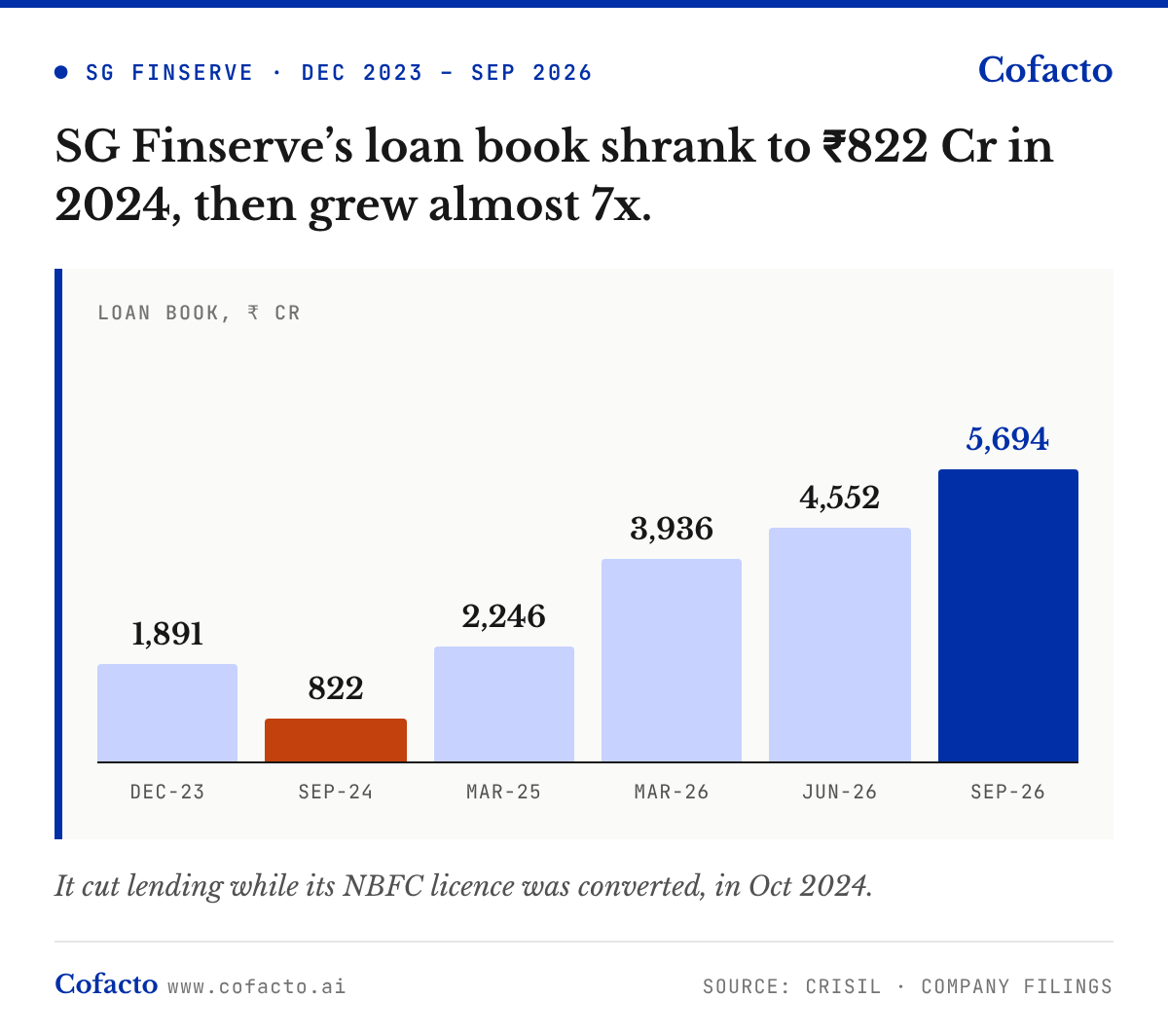
As it grew back, it lent beyond APL Apollo. Crisil puts the non-APL share of the book at 12% in March 2023 and 73% in June 2026. On the Q2 FY27 call, management put the group ecosystem at about 25% of loans.
In rupees, the APL Apollo book kept growing. Multiply each share by the loan book on the same date, and loans linked to APL Apollo went from about ₹858 crore to about ₹1,424 crore.

The APL Apollo book is bigger today than when it made up 88% of the company. Over the same period, loans outside APL Apollo went from about ₹117 crore to about ₹4,270 crore.
SG Finserve doesn’t split profit by anchor. If those loans earn what the rest of the book earns, they made about ₹28 crore of the ₹112 crore first-half profit. This is our arithmetic.
Management hasn’t always used the same number, either. On another occasion, per call transcripts, it described APL Apollo as about a third of the book, historically and going forward.
The bigger link: who stands behind the borrowing
A lender like SG Finserve makes money on the gap between what it charges and what it pays to borrow. So the price of its own borrowing matters as much as who it lends to.
The Gupta family backs much of that borrowing. SG Finserve’s FY26 annual report says its bank term loans carry an unconditional and irrevocable corporate guarantee from S Gupta Holding, plus personal guarantees from Sanjay, Rahul and Rohan Gupta. Most of its bank demand loans carry the same guarantees. A ₹400 crore working-capital loan has only the personal guarantees, and a ₹50 crore overdraft is backed by fixed deposits.
The guarantee limit went up this year. On 12 March 2026, per the FY26 annual report, shareholders approved a higher limit on S Gupta Holding’s corporate guarantee. Net borrowings had roughly doubled in the year, from ₹1,337 crore to ₹2,654 crore. The new limit isn’t disclosed. So while the loan book was moving away from APL Apollo, the borrowing was leaning more on the family.
Crisil’s September 2026 report says that as of June 2026, nearly two-thirds of SG Finserve’s debt was guaranteed by the promoter group. On Crisil’s own June figures, that’s roughly ₹2,200 crore. The filings don’t say how much of it S Gupta Holding covers and how much the individual family members do.

The guarantee shows up most clearly in ICRA’s ratings. ICRA rates SG Finserve A+ on its own. On loans backed by the S Gupta Holding guarantee, it simply carries over the guarantor’s rating, giving AA(CE). The guarantee is worth two notches.
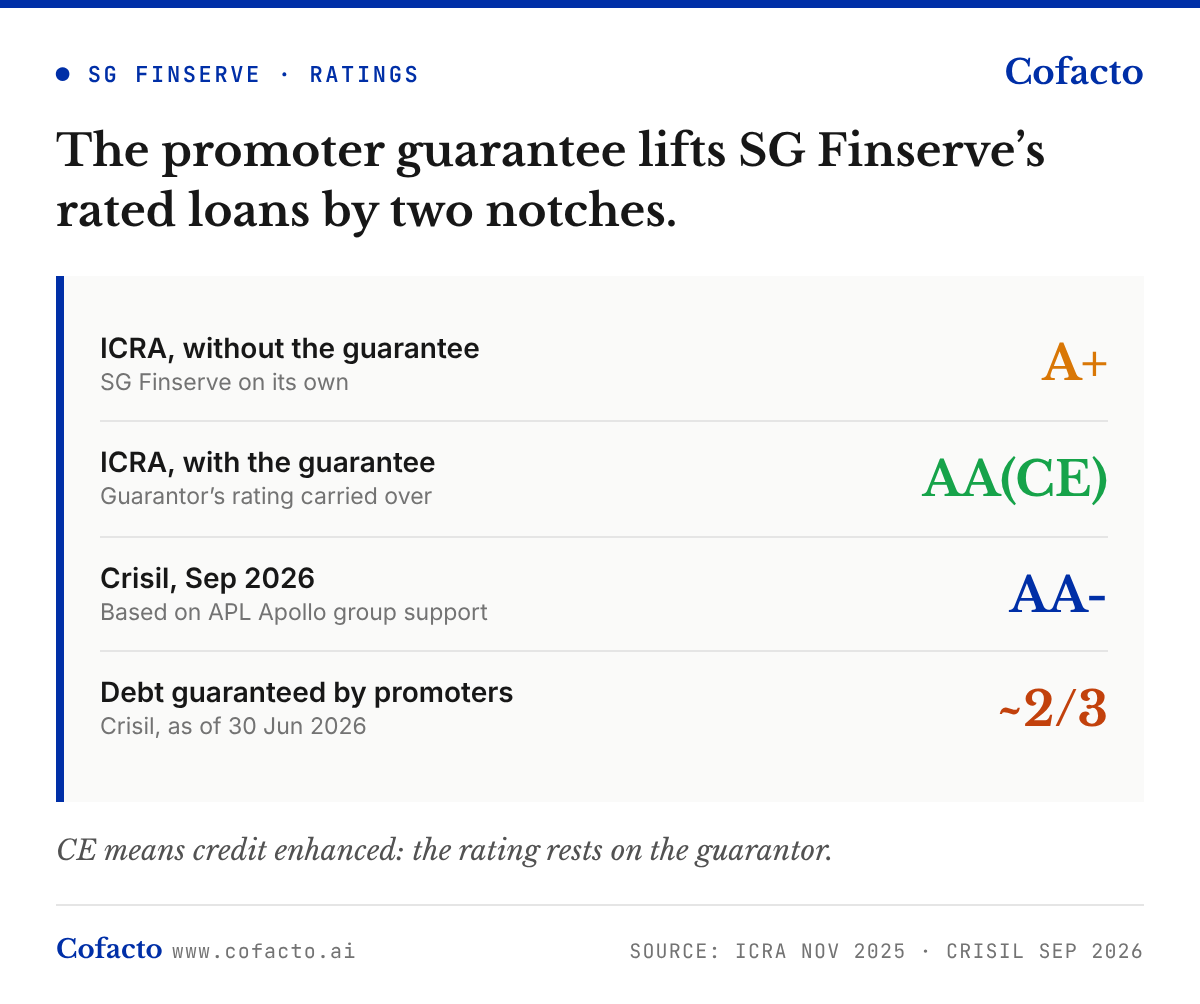
The guarantor’s strength has mostly come from its APL Apollo shares. In 2023, Crisil said S Gupta Holding’s stake was worth about nine times its debt plus the ₹1,000 crore guarantee it had then given to SG Finserve.
What the sale does to the guarantor
That stake is now being sold, and the sale turns shares into cash. The first tranche alone, ₹5,825 crore, is about 2.6 times the SG Finserve debt the family guarantees, on our estimate. All three tranches add up to ₹15,511 crore. Sanjay Gupta put the family’s post-tax amount at ₹12,000–13,000 crore.

S Gupta Holding will have more cash to meet the guarantee if it is ever called. S Gupta Holding’s own 7.04% stake in SG Finserve is worth about ₹294 crore, a fraction of the debt it stands behind. And once all three tranches are done, it will own no APL Apollo shares at all.
The filings don’t say whether the family will keep backing SG Finserve’s borrowing once it no longer runs SG Finserve’s first customer. S Gupta Holding is a private company, and nothing public shows what it will do with the money.
What the rating agencies are watching
The two agencies now read SG Finserve differently. Crisil’s guarantee-backed AA(CE) ratings were withdrawn in April 2026. In September, it rated SG Finserve AA- instead, based on SG Finserve’s own numbers plus “strong support” it expects from the APL Apollo group. ICRA, in its latest announcement in October, still carries AA(CE), resting on the S Gupta Holding guarantee. ICRA lists a major change in shareholding or expected group support among the things that could move its rating.
Crisil’s report lists what could pull its rating down. Two of them:
- Any change in the stance of support by APL Apollo group. Crisil also names APL Apollo’s Group CFO, Deepak Goyal, as an SG Finserve board member alongside Rohan Gupta.
- Gearing rising beyond 3.5–4 times, significantly and for long.
Crisil wrote this on 21 September, two months before the deal. It describes SG Finserve as part of the APL Apollo group, and its flagship as APL Apollo. After closing, APL Apollo will be controlled by Tata Steel. No rating agency has commented on SG Finserve since the deal.
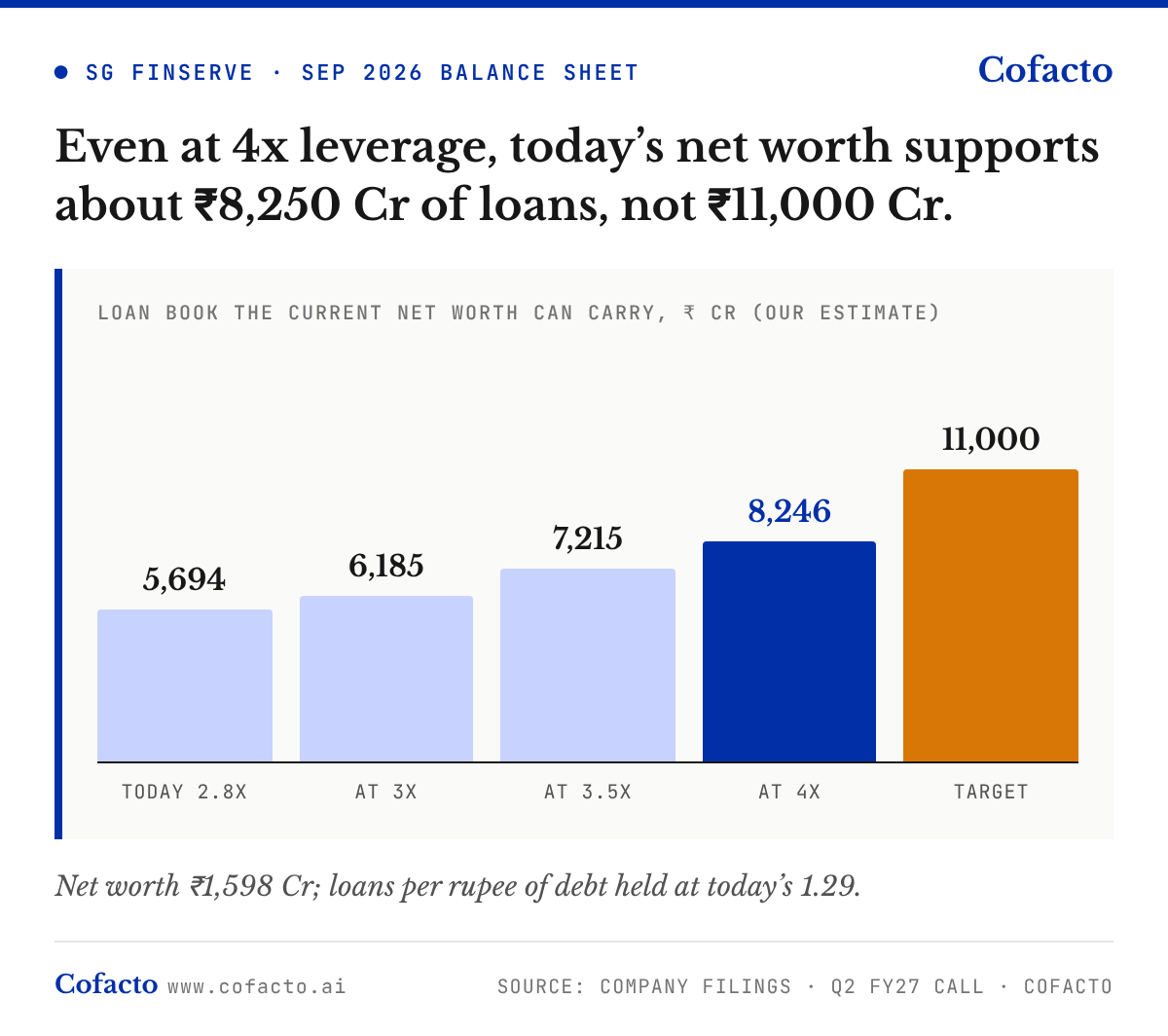
On the Q2 FY27 call, management raised its leverage limit to 4 times net worth, aiming for about ₹11,000 crore of loans in two to three years. SG Finserve is also asking shareholders, by postal ballot on 3–4 December, to let it borrow up to ₹10,000 crore.

The 4x limit is at the top of the range Crisil flags. Every percentage point on its roughly ₹4,400 crore of borrowings is about ₹44 crore a year before tax, our arithmetic. Management guides for about ₹225 crore of profit in FY27.
At 4 times its September net worth of about ₹1,598 crore, SG Finserve could carry roughly ₹8,250 crore of loans, our arithmetic. The ₹11,000 crore target needs about three more years of retained profit, or new equity.
Could Tata Steel take the dealers elsewhere?
Nothing public stops it. We found no exclusivity, and no clause that says what happens to SG Finserve’s arrangements if APL Apollo changes hands. The agreement itself hasn’t been published.
The stop-supply tool belongs to APL Apollo. It is APL Apollo that cuts off a dealer who doesn’t repay. After closing, Tata Steel will be APL Apollo’s promoter and can put its own directors on the board.
Tata Steel already has a lender in the family. Tata Capital factors Tata Steel’s sales to customers: it pays Tata Steel upfront and takes the risk of the customer not paying, with no recourse to Tata Steel. Tata Capital’s shareholders have been asked to approve up to ₹15,060 crore of such dealings with Tata Steel in FY27. Tata Steel also runs its own dealer-finance programme, Urja, which covered more than 700 dealers, per its disclosures.
Management has made an upside case. Tata Steel’s tubes business brings more dealers into APL Apollo’s network, and SG Finserve already knows how to lend to that kind of dealer.
SG Finserve’s Q3 FY25 presentation showed a ₹50 crore dealer-finance programme with Tata Steel, next to ₹1,000 crore with APL Apollo. We found no disclosure that any money was lent under the Tata Steel line, and no new mandate since the deal.
The business on its own
In the six months to September, SG Finserve’s loan book nearly doubled and profit more than doubled. It has never reported a bad loan.
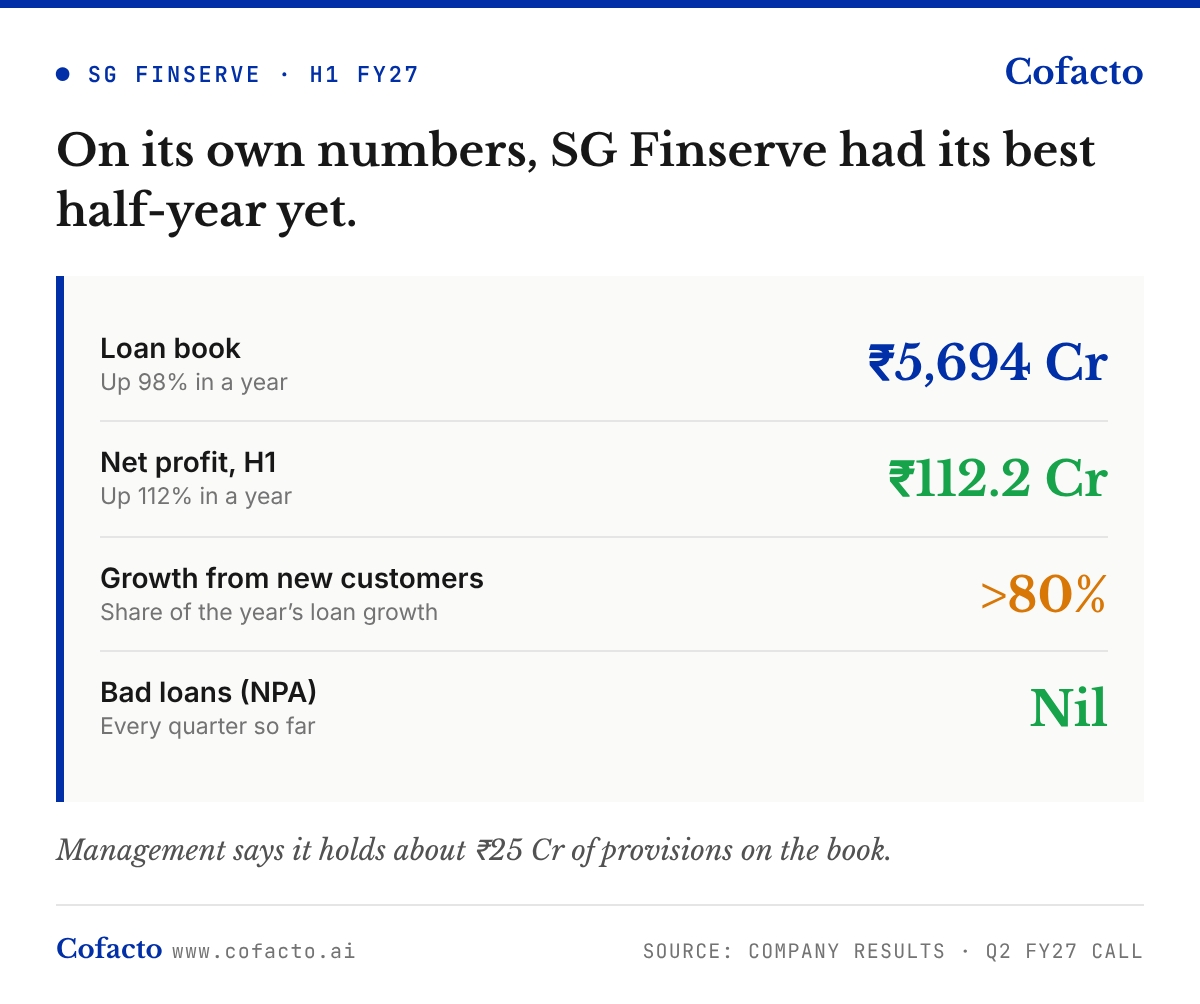
More than 80% of the year’s loan growth came from new customers, so most of the book is young and hasn’t been through a bad year. And provisions are thin: about ₹25 crore on a ₹5,700 crore book, per management, or under 0.5%. Crisil puts its credit cost at about 0.1% a year so far.
Losing every APL Apollo loan would cost about ₹56 crore of yearly profit, if those loans earn the book average. Bad loans at 2% of the book a year would cost about ₹85 crore. At 1%, about ₹43 crore.

At ₹633 on 27 November, after the fall, SG Finserve still traded at about 2.6 times book value. Five listed MSME and supply-chain lenders traded at a median of about 1 times. Over the 12 months before the deal, SG Finserve rose 56% while those peers fell 20% to 55%, per Cofacto’s data.
Foreign investors held 0.07% of SG Finserve in September 2025 and 1.00% a year later. Mutual funds held about 1.4%. The promoters’ stake rose from 48.38% to 56.95% over the same year. The first shareholding pattern after the fall, for December, will show who sold.
Why this stays open until 2028
The family doesn’t exit APL Apollo in one go. The second tranche comes at closing, which Tata Steel targets for March 2027. The third is due by 31 March 2028. S Gupta Holding stays a guarantor of SG Finserve’s debt through that period unless the terms change. SG Finserve’s ₹11,000 crore plan runs over the same two to three years.

What to watch
- 3–4 December: the shareholder vote on borrowing up to ₹10,000 crore.
- 8 December: Tata Steel’s detailed public statement for the APL Apollo open offer.
- Any SG Finserve filing on whether the S Gupta Holding guarantee continues, and on what terms.
- The next Crisil and ICRA reports, and whether they still call SG Finserve part of the APL Apollo group.
- The Q3 FY27 call: the APL Apollo share of loans, borrowing costs, and whether anything was lent under the Tata Steel line.
How we worked it out
Facts come from rating reports, annual reports and results; anything we calculated is labelled as ours.
- APL Apollo-linked loans = share of book (Crisil, management) × loan book on the same date.
- Profit share assumes those loans earn the book average; SG Finserve doesn’t disclose it.
- Guaranteed debt in rupees uses Crisil’s June 2026 gearing (2.2x) and net worth (₹1,539 crore).
- Loan capacity = net worth × leverage × today’s loans per rupee of debt (1.29). Profit hits use a 25% tax rate.
Sources
- Crisil Ratings: SG Finserve rating rationales, 21 Sep 2026, 30 Sep 2025, 25 Apr 2025; 4 Jul 2023
- ICRA: SG Finserve rating rationale, 4 Nov 2025
- SG Finserve: FY25 and FY26 annual reports; Q3 FY25 presentation; Q2 FY27 results, presentation and call (16 Oct 2026); shareholding pattern (Sep 2026); November 2026 filings: via Cofacto
- APL Apollo and Tata Steel: deal filings, presentations and calls, 22–23 Nov 2026: via Cofacto
- Tata Capital: postal ballot notice, May 2026
- ICRA: SG Finserve rating announcement, Oct 2026: via Cofacto
- Prices, valuations, shareholding and peer data (27 Nov 2026): Cofacto; press coverage: Business Standard, Moneycontrol, Trade Brains
Not a SEBI-registered Research Analyst or Investment Adviser. This is not a recommendation to buy, sell or hold any security, and not investment advice. Consult a SEBI-registered RA or IA before any investment decision. Complaints cannot be raised with SEBI for this content. Built with AI from public filings, rating reports and public price data; it may be incomplete or incorrect.
Analysis on Cofacto · www.cofacto.ai
Ask about this
Ask Cofacto a question about this piece. Answers cite filings and company data.
More in Research
- Why Are APL Apollo and Tata Steel Even Doing This?Company deep-dives · Nov 2026
- The curious case of Taparia ToolsCompany deep-dives · Nov 2026
- Ola needs 2.6x today’s sales to cover its running costs. We ran the numbers.Company deep-dives · Nov 2026